
Blog
Social
Act 11: What Pennsylvania Parents Should Know About the New Child Custody Law
11.26.2025
Act 11 of 2025 Pennsylvania updates how courts evaluate child custody cases by reducing the number of legal factors from 16 to 12 while emphasizing child safety. Signed by Josh Shapiro, the law streamlines custody evaluations and clarifies how courts consider cooperation, abuse concerns, and parental responsibilities when determining a child’s best interests.


Handling legal custody matters can be an emotionally overwhelming process – for you and your child. You may be in the middle of a divorce or trying to formalize an agreement with your child’s other parent. Whatever the situation, your child’s well-being should always come first.
With the passage of Act No. 11 of 2025 earlier this year, Pennsylvania has introduced new rules that directly affect how courts evaluate custody cases. Understanding these changes can make a real difference in your case. Working with an experienced child custody attorney in Pennsylvania can also help you advocate more effectively for your child’s best interests.
Overview of Act 11 of 2025
On June 30, 2025, Pennsylvania Governor Josh Shapiro signed House Bill 378 into law, Act No. 11 of 2025. This revises Section 5328(a) of Title 23 of the Pennsylvania Consolidated Statutes, specifically the Domestic Relations Code.
In the past, court decisions on child custody cases were based on 16 factors outlined within that section. Rather than rewriting the entire section, Act 11 consolidates many of these factors, reducing the number of factors judges need to consider to 12.
Act 11 took effect on August 29, 2025, 30 days after the bill was signed.
What Act 11 Changes in Custody Cases
The following changes have been made to the list of factors in Section 5328(a):

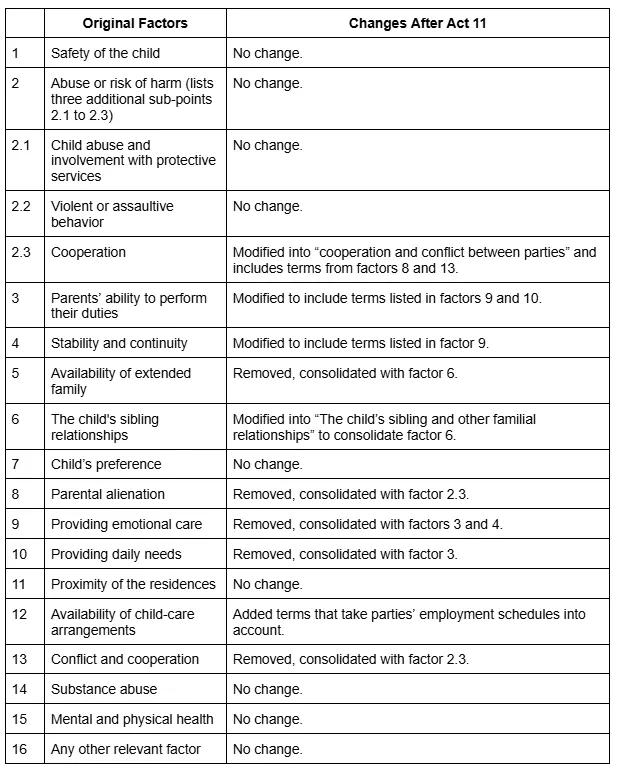
How Act 11 Protects Child Safety
One of the overriding themes of Act 11 is that the court’s focus remains on protecting the child’s safety and best interests. If you have a family law case involving child custody, this matters for you in several ways.
Safety Takes Priority
Section 5328(a) requires substantial weighted consideration in Factors 1 to 2.2. This means that, among all the factors, the safety of a child against violence and abuse at home should be one of the top considerations when a judge decides custody arrangements.
In other words, a history of abuse, neglect, protective orders, or assaultive behavior will have a bigger impact on custody decisions. If you have concerns about your child, the changes provide clarity to protect their interests.
Protection for Parents
While Factor 2.3 is consolidated to consider both cooperation and conflict, House Bill 378 puts caveats in cases of abuse. Reasonable safety actions in instances of abuse aren’t considered alienation; protecting a child or oneself doesn’t show noncooperation or blame for a strained relationship.
The law explicitly states that if you take reasonable action in good faith to protect your child, that will not be counted against you as “unwillingness to cooperate.” For example, if you refuse the other parent to have visitation because of their history of abuse towards your child, this cannot be used against you in court.
Clearer Path for Evidence
With the written factors and the streamlined structure, you and your Pennsylvania child custody lawyer can map your evidence directly to what the law requires the court to examine. That means you’re more prepared, and the process is potentially more transparent.
Impact on Existing Custody Orders
Parents with existing custody orders may wonder if Act 11 will supersede any existing rulings. The general answer is that your custody ruling remains in effect. However, future modifications and filings to your existing custody arrangements will be evaluated in accordance with the updated list.
All custody complaints and petitions filed after August 29, 2025, will be evaluated in accordance with the revised factors. Because the transition period matters, discussing your situation with a child custody attorney in Pennsylvania who’s up-to-date on Act 11 will help you determine whether the new factors apply to your case.
How Act 11 Affects Parents Who Share Custody
For parents in shared custody arrangements, the changes under Act 11 bring some implications.
Cooperation and Conflict
If you share parenting time with the other parent, your ability to cooperate and preserve relationships will be evaluated under the new streamlined factors. The clearer language around cooperation means that your behavior (and the other parent’s) becomes more transparent in the court’s review.
Stability, Continuity, and Safety
Factors such as the child’s relationships, education, community, and other relevant considerations are important. However, because safety factors are given substantial weight, concerns about abuse, neglect, or risky behavior can allow shared custody arrangements to be revisited using the new framework.
Preparing Your Co-Parenting Strategy
You’ll want to work proactively with a qualified attorney to show how your shared custody plan meets the updated standard. For instance:
- Does your custody arrangement provide your child with a stable environment?
- Can you and your child’s other parent conduct safe and civil exchanges?
- Can you and the other parent communicate effectively?
Act 11 and Parental Relocation
While Act 11 doesn’t directly overhaul the separate relocation statute, its changes indirectly affect any move involving custody. If you’re considering moving with the child within Pennsylvania or out of state, the standard remains that the relocating parent must either obtain the other parent’s agreement or seek court approval.
When the court evaluates a relocation request, the “best interests of the child” standard still applies. However, the streamlined factors of Act 11 will apply, meaning the following can have weight in your filing:
- How your relocation respects the child’s safety
- How the move will affect your child’s stability, community, school, sibling/ familial relationships
- Whether the move will impact their contact with the other parent
- Whether the other parent’s employment schedule, care availability, and other considerations may provide a more stable home environment
If you anticipate relocation is on the table, you should consult with an experienced Pennsylvania custody law attorney who knows how Act 11 will impact your filing.
What Parents Should Do Now
- Review Your Current Orders and Filings: Depending on the filing date, your custody case may be evaluated under the old or new factor list.
- Document Everything: Keep clear records of your parenting time, how you provide for your child’s emotional, educational and developmental needs, your scheduling/availability, and any safety concerns.
- Understand the Factors: Map your evidence and arguments to those factors. A good child custody attorney in Pennsylvania will help you do that.
- Cooperate With the Other Parent: Because cooperation is made clearer in custody cases, you need to be reasonably cooperative (when safe to do so) and avoid deterring your child from having a relationship with them.
- Plan Ahead. If life events require you to move or modify your existing custody arrangements, consult legal counsel.
How a Pennsylvania Family Law Attorney Helps
Hiring a qualified child custody attorney in Pennsylvania means you’ll have someone who can:
- Interpret exactly how Act 11 applies to your case
- Map your evidence to the 12 factors
- Help you prepare for family law hearings, mediation or settlement negotiations
- Represent your child’s safety interests
- Advocate on your behalf
Spearheaded by Ryan D. Very, Esq., Very Law stays current on Pennsylvania’s evolving laws. We understand how Act 11 reshapes the landscape and how it may affect your family’s path forward. If you’re navigating a custody dispute now or anticipate one in the future, don’t go it alone.
Connect with Very Law today to review your case, understand how the updated Pennsylvania child custody law applies, and develop a tailored strategy.
Frequently Asked Questions
When does Act 11 take effect?
It takes effect 60 days after being signed, so any custody filing submitted after August 29, 2025, will apply the revised factors.
Does the change automatically apply to my existing custody order?
Existing orders do not automatically change, but if you file a new action or modification after the effective date, the new law will apply.
Do I need a new child custody attorney because of the change?
While not required, working with an attorney who is familiar with Pennsylvania custody law and the changes under Act 11 can help you position your case effectively.


Ryan D. Very, Esq.
Proprietor
Ryan Very spearheads one of Pittsburgh’s fastest-growing, most well-respected law firms. He’s built a full-service practice working with a diverse array of clients: trade associations, teachers, business owners, unions, large corporations, and the ordinary citizen.